Pearson Edexcel · GCSE · History
Course version: 1HI0 · Version from Sept 2016
C1500–c1700: Crime and punishment in early modern England - 2 The nature…
Full specification wording
Option 10: c1500–c1700: Crime and punishment in early modern England - 2 The nature of law enforcement and punishment: The role of the authorities and local communities in law enforcement, including town watchmen.
Law enforcement in early modern England relied heavily on local communities, though the role of authorities expanded.
Checked against the Pearson Edexcel 1HI0 specification (opens in a new tab) on .
- Point 1 of 2
- 3 key terms
Study notes
From the checked teaching notes for this specification point.
The idea
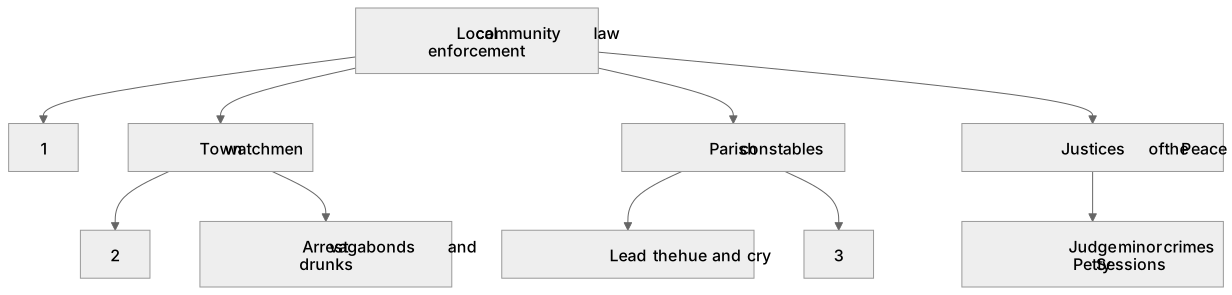
Law enforcement in early modern England relied heavily on local communities, though the role of authorities expanded. The traditional hue and cry remained crucial, requiring citizens to chase suspects. However, as towns grew, community-led enforcement became less effective, prompting the introduction of town watchmen. These watchmen patrolled streets at night, carrying lanterns and bells, to deter criminals and arrest vagabonds. Alongside them, unpaid parish constables held daytime responsibilities, and Justices of the Peace (JPs) judged minor crimes at Petty Sessions.
What earns the marks
- Describe the continuing role of the local community in law enforcement, such as the use of the hue and cry.
- Explain the duties of town watchmen, including night patrols, arresting drunks and vagabonds, and maintaining order in growing urban areas.
- Outline the responsibilities of the parish constable in leading the hue and cry and assisting the town watchmen.
- Analyse the role of Justices of the Peace (JPs) in enforcing the law and judging cases at Quarter and Petty Sessions.
Common mistakes and how to put them right
Confusing town watchmen with a modern professional police force.
Put it right: Watchmen were unpaid, often reluctant citizens fulfilling a civic duty, not trained professionals.
Assuming the hue and cry disappeared.
Put it right: It continued to be a primary method of catching criminals in rural areas despite the introduction of watchmen in towns.
Overstating the effectiveness of town watchmen.
Put it right: They were frequently mocked for being old or incompetent, rather than being a highly effective deterrent.
Exam tips
- Highlight the link between population growth in towns and the need for new law enforcement methods like town watchmen.
- Contrast the roles of the parish constable, who had daytime and broader duties, with the town watchman, who patrolled at night.
- Use the role of JPs to demonstrate how the monarch maintained authority over local law enforcement.
Try the lesson
The start of the Option 10: c1500–c1700: Crime and punishment in early modern England - 2 The nature of law enforcement and punishment: The role of the authorities and local communities in law enforcement, including town watchmen. lesson, made from checked teaching notes for this specification point.
Have a go first
What was the primary role of a town watchman in early modern England?
Listen
Law enforcement in early modern England relied heavily on local communities, though the role of authorities expanded. The traditional hue and cry remained crucial, requiring citizens to chase suspects. However, as towns grew, community-led enforcement became less effective, prompting the introduction of town watchmen. These watchmen patrolled streets at night, carrying lanterns and bells, to deter criminals and arrest vagabonds. Alongside them, unpaid parish constables held daytime responsibilities, and Justices of the Peace (JPs) judged minor crimes at Petty Sessions. A strong answer earns marks for these points. Describe the continuing role of the local community in law enforcement, such as the use of the hue and cry. Explain the duties of town watchmen, including night patrols, arresting drunks and vagabonds, and maintaining order in growing urban areas. Outline the responsibilities of the parish constable in leading the hue and cry and assisting the town watchmen. Analyse the role of Justices of the Peace (JPs) in enforcing the law and judging cases at Quarter and Petty Sessions. Exam tip: Highlight the link between population growth in towns and the need for new law enforcement methods like town watchmen.
See it

Key words
Say what each word means before you turn the card.
Town watchmen
Try answering aloud or in your head before turning the card.
Hue and cry
Try answering aloud or in your head before turning the card.
Justices of the Peace (JPs)
Try answering aloud or in your head before turning the card.
See every definition
- Town watchmen
- Men who patrolled streets at night, carrying lanterns and bells, to deter criminals and arrest vagabonds.
- Hue and cry
- A traditional method requiring citizens to chase suspects, which remained crucial in law enforcement.
- Justices of the Peace (JPs)
- Officials who judged minor crimes at Petty Sessions.
Label the diagram
Some boxes have lost their names. Pick the right name for each number.
1Box 1
2Box 2
3Box 3
There is more to this lesson
The full lesson goes on to check your understanding and help you earn the marks. Create a free account to carry on, with your progress saved.
A week of Premium from your first lesson · Then the free plan continues · No card, no charge
Test your understanding of Option 10: c1500–c1700: Crime and punishment in early modern England - 2 The nature of law enforcement and punishment: The role of the authorities and local communities in law enforcement, including town watchmen.
Active recall beats re-reading. Take an instant quiz now to test what you’ve learned and lock it into long-term memory.
A week of Premium from your first lesson · Then the free plan continues · No card, no charge